
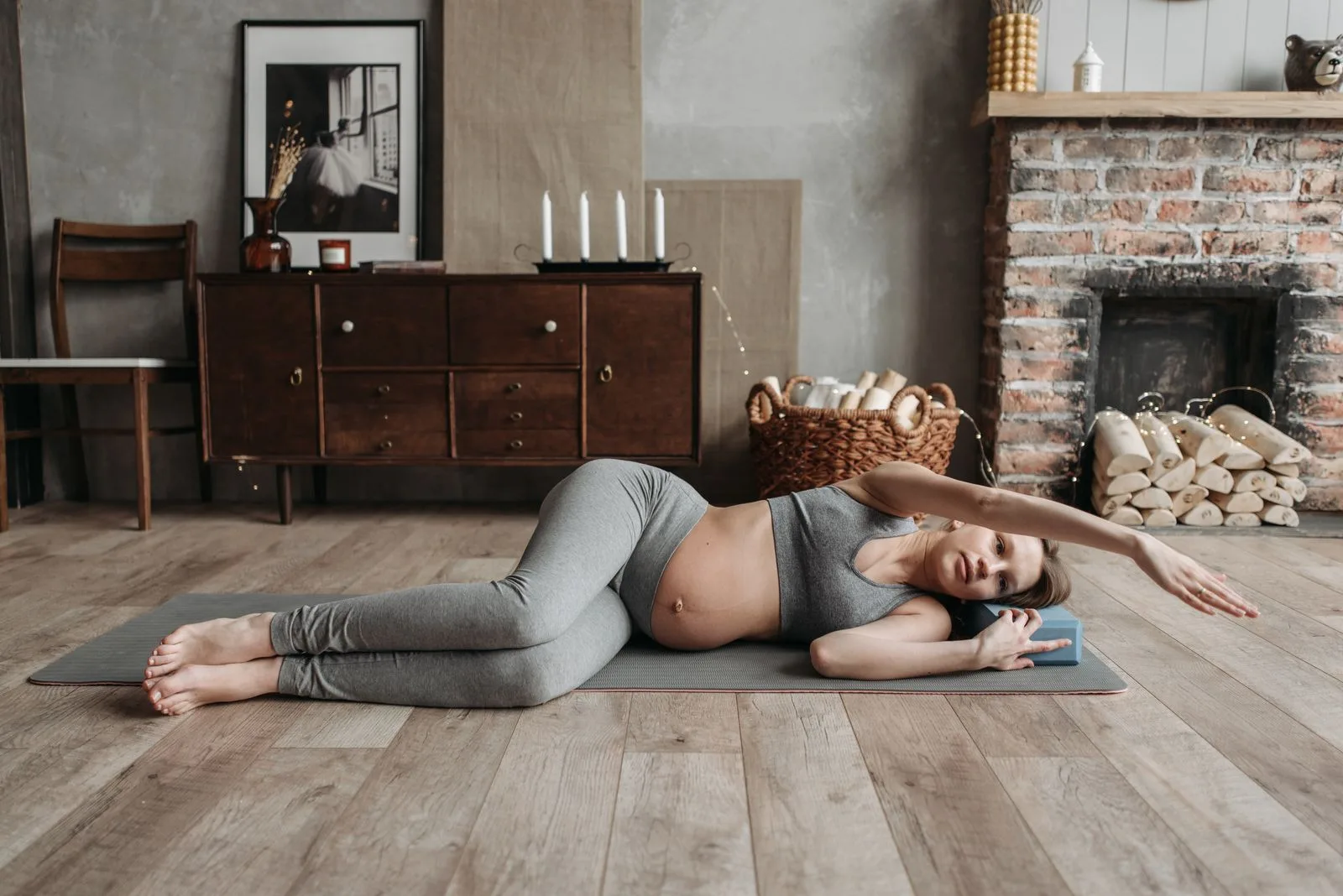
A lot of pregnancy advice treats the pelvic floor like something to strengthen, the same way you'd train any other muscle. But labour asks these muscles to do something different: stretch open wide enough for a baby to pass through, then recover afterward. Getting ready for that means paying attention to release and coordination alongside strength, with a handful of specific exercises that pelvic health physiotherapists use to prepare patients for delivery.
Here are those exercises, what the research says about perineal massage and pushing technique, and when it's worth seeing a pelvic health physiotherapist directly.
Key Takeaways
- Preparing the pelvic floor for birth involves learning to relax and lengthen these muscles, alongside any strengthening work, though the right balance depends on whether your pelvic floor runs weak, overactive, or a mix of both.
- Physiotherapists commonly teach four exercises for birth preparation: the pelvic floor drop, deep squats, perineal bulging, and child's pose. These are grounded in physiotherapy practice and biomechanical reasoning rather than large clinical trials.
- Perineal massage from around 34 to 35 weeks has the strongest trial evidence of any technique here: a Cochrane review of over 2,400 women found it reduced the need for stitches and lowered episiotomy rates, especially for first-time vaginal births.
- How you push matters, though not for every birth. Spontaneous pushing is linked to less fatigue and less strain on the bladder and pelvic floor than coached breath-holding, but directed pushing still has a place with an epidural, a prolonged second stage, or fetal concerns.
- Perineal bulging is more debated among pelvic health physiotherapists than perineal massage, and carries specific timing and safety restrictions.
- A pelvic health physiotherapist can assess what your pelvic floor needs - coordination, strength, or release - and build a plan around that, since not everyone needs every exercise here.
What Preparing the Pelvic Floor for Birth Involves
The pelvic floor is a sling of muscle running from your pubic bone to your tailbone, supporting your bladder, bowel, and uterus. During a vaginal birth, this sling stretches far beyond its everyday range to let your baby's head through.
Most pelvic floor advice during pregnancy is aimed at preventing leaks after birth, and centres on strengthening - contract, hold, release, repeat. Birth preparation adds another layer to that. A pelvic floor that is strong but does not release well under pressure may add resistance during pushing, at least in theory, though this has not been directly tested in large studies. One that lengthens and yields more easily is generally thought to make room without as much resistance.
In practice, that usually comes down to three things: tissue that can stretch without tearing, muscles that have practised letting go under increasing pressure, and a pushing style that works with your body.
Relaxation Matters as Much as Strength
A pelvic floor that is chronically gripped or overactive, sometimes called hypertonic, may make it harder to relax under pressure during labour, since constant tension leaves less room for a muscle to lengthen. Some pelvic health physiotherapists shift a prenatal plan in the third trimester toward teaching the pelvic floor to soften and lengthen on cue. This is not universal, and it is not the right approach for everyone: some people have pelvic floors that are weak, some are overactive, and some are a mix of both, so the right plan depends on what is actually going on for that person.
Some people work with a pelvic health physiotherapist, who can check - often with an internal exam - whether the pelvic floor tends to run tight, weak, or both, and build a plan around that. Strength training still has a place in this picture for people who need it. It just is not the whole plan for everyone.
Exercises to Try
Physiotherapists who specialise in prenatal and pelvic health, including a team at UT Southwestern Medical Center, commonly teach a small set of exercises for birth preparation, usually starting in the third trimester. It's worth knowing upfront that these rest on different levels of evidence. Perineal massage, covered separately below, has the most trial data behind it. The exercises here are grounded in physiotherapy practice and biomechanical reasoning, but haven't been tested in the same way for their effect on labour outcomes specifically. None require equipment, and not everyone needs all of them - a pelvic health physiotherapist can help sort out which apply to you.
The pelvic floor drop (reverse Kegel)
Labour asks the pelvic floor to lengthen and release under pressure, the opposite of what a standard Kegel contraction trains. This exercise builds the sensation of releasing the pelvic floor on cue, which is what's needed during the pushing stage of labour.
Technique. Lie on your back with your knees bent, or sit if that is more comfortable later in pregnancy. Inhale slowly, letting your belly rise, and picture your pelvic floor softening and dropping open as you breathe in. Exhale and let everything return to rest, without actively lifting or squeezing. Ten slow breaths, once or twice a day, is enough to build the habit.
Deep squat
Physiotherapists use this position because the deep squat is thought to help relax and lengthen the pelvic floor muscles and stretch the perineum, the same tissue that stretches during delivery. This is a biomechanical rationale grounded in physiotherapy practice rather than a technique tested in trials for reducing tears or shortening labour.
Technique. Stand with your feet wider than hip-width, toes turned slightly out, and lower into a squat as far as feels comfortable, with your hands pressed together in front of you or holding onto a wall or chair for support. A pelvic health physiotherapist can advise on how deep to go and how often to practise, since this can vary by individual.
Perineal bulging
This exercise trains the pushing motion itself, teaching you to bear down without holding your breath, so the movement is already familiar by the time you're in labour. It's a more debated technique than most on this list: some pelvic health physiotherapists teach it routinely, others don't, and the evidence for its effect on birth outcomes specifically is limited compared with perineal massage.
Technique. Sit on a small towel rolled lengthwise, with the towel pressing against the perineum, the area between the vagina and rectum. Gently press the perineum down into the towel, imagining the sit bones moving apart and the tailbone moving away from the pubic bone, breathing out as you do it rather than holding your breath. A mirror can help confirm the movement is going down and out rather than up and in, which would be a Kegel instead.
Perineal bulging comes with real caveats. It is typically recommended only in the last three weeks of pregnancy, and not practised often, since repeated bulging can put excessive pressure on pelvic floor structures. It should not be attempted if you have premature rupture of membranes, vaginal bleeding, or pelvic organ prolapse. Talk with your provider or a pelvic health physiotherapist before starting, and let them guide how often to do it and whether it is a good fit for you at all.
Child's pose
This yoga pose is used in prenatal physiotherapy mainly as a comfort and mobility exercise. It's thought to help lengthen the pelvic floor muscles and ease general tension, though it's not something research has linked directly to labour outcomes.
Technique. Kneel and sit back onto your heels, then walk your hands forward and lean your torso down between your knees, spreading your knees wider as your belly grows to make room. Avoid letting your hips lift higher than your heart, and sit up higher if resting back on your heels is not comfortable.
Perineal Massage: What the Evidence Shows
Most vaginal births involve some degree of perineal trauma, according to a 2024 review in the American Journal of Obstetrics & Gynecology, which is part of why prevention strategies have drawn research interest.
Perineal massage - gently stretching the tissue between the vagina and anus, usually starting around 34 to 35 weeks - is one of the pelvic floor birth-prep techniques with the most trial evidence behind it.
A Cochrane review pooling four randomised trials and close to 2,500 women found that antenatal perineal massage reduced the likelihood of perineal trauma requiring stitches and lowered episiotomy rates. The effect was clearest for women having their first vaginal birth. For women who'd given birth vaginally before, the benefit on trauma was smaller and less consistent, though that group reported significantly less ongoing perineal pain at three months postpartum.
The technique itself is simple: using a clean thumb or finger and a lubricant such as a natural oil, apply gentle, steady pressure downward and to the sides of the vaginal opening for a few minutes, a few times a week. It can be done alone or with a partner. More is not automatically better - most of the trials behind the Cochrane review used sessions of five to ten minutes, a handful of times a week.
It's worth setting expectations honestly: massage lowers the odds of tearing and stitches. It does not guarantee an intact perineum, and factors like your baby's size and position are outside its reach.
Breathing and Pushing Technique
How you push in the second stage of labour affects your pelvic floor, and it's an area where common hospital practice hasn't always kept pace with the evidence.
Directed pushing, sometimes called Valsalva pushing, involves taking a breath, holding it, and bearing down hard on cue from a birth attendant. Spontaneous pushing means following your own body’s urge to push, breathing and vocalising as feels natural, without holding your breath through each contraction.
A systematic review of randomised trials comparing the two found no support for routinely using Valsalva pushing. Coached breath-holding shortened the second stage of labour by a small amount, but babies fared the same either way, and Valsalva pushing was linked to measurable strain on the bladder and pelvic floor afterward, including reduced bladder capacity and a delayed first urge to urinate three months postpartum. Spontaneous pushing has also been associated with less maternal fatigue.
This doesn't rule out directed pushing altogether. With an epidural, sensation is often reduced enough that spontaneous pushing isn't really possible, and directed pushing may be the more practical option. It can also be the right call if the second stage is dragging on, if there are concerns about the baby, or if exhaustion has set in and someone needs clearer direction to keep going. Which approach fits best is something to work out with whoever's attending your birth, based on how things are unfolding at the time.
Practising open-glottis breathing before labour - breathing and making low, open sounds on the exhale instead of holding your breath - gives you a pattern to fall back on when things get intense. It's worth rehearsing ahead of time rather than working it out mid-contraction.
Positions and Movement Worth Knowing About
Upright and side-lying positions during pushing work with gravity and give the pelvis more room to shift than lying flat on your back. There is no single position that suits everyone, and mobility can be limited by monitoring, an epidural, or what feels manageable in the moment. Practising a few options ahead of time - hands and knees, side-lying, supported squatting - gives you real alternatives to reach for when things speed up.
When to See a Pelvic Health Physiotherapist Before Birth
You don't need a referral or a specific problem to see a pelvic health physiotherapist during pregnancy. Many people book a session in the third trimester purely for birth preparation: to check how well the pelvic floor releases under pressure, to be shown perineal massage and perineal bulging technique directly, and to practise pushing mechanics before labour.
It's a particularly good idea if you've had pelvic pain, a previous difficult birth or significant tear, ongoing leakage, or a history of pelvic floor tension. A therapist can tell you whether your pelvic floor needs more strength, more coordination, or more release, and shape a plan around those findings rather than a generic list of exercises.
Frequently Asked Questions
Should I still do Kegels to prepare for birth?
Kegels have their place for pelvic floor strength and postpartum recovery, but strength alone does not get you through the pushing stage. Pairing any strengthening work with relaxation and lengthening practice - the pelvic floor drop, deep squats, perineal massage, a pelvic health physiotherapist if needed - matches what the pelvic floor needs to do during birth more closely than Kegels on their own.
When should I start perineal massage?
Most of the trial evidence is based on starting around 34 to 35 weeks and continuing a few times a week until birth. Starting earlier than that hasn't been shown to add benefit, and there's no need to rush into it before the third trimester.
Does pelvic floor prep guarantee I will not tear?
No. It shifts the odds in your favour, particularly for a first vaginal birth, but it doesn't remove the role of factors like your baby's size, position, and how your labour unfolds. Think of it as stacking the odds, not guaranteeing an outcome. Some people who do everything right still tear, and that isn't a sign anything was done wrong.
Is it too late to start if I am already close to my due date?
It's rarely too late to start breathing practice or the pelvic floor drop, and perineal massage can still offer some benefit even started later in the third trimester. A pelvic health physiotherapist can help you prioritise what's likely to matter most in the time you have left, rather than trying to fit everything in at once.
Will an epidural change any of this?
It changes what you can feel and how mobile you are, but not the underlying mechanics. Breathing and positioning strategies can usually be adapted with a support person or care team even if you cannot move as freely, and pushing coaching often shifts to relying more on feedback from your care team about contractions since the urge to push may be harder to sense.
Is perineal bulging safe to do on my own?
It carries more restrictions than the other exercises here. It's generally recommended only in the last three weeks of pregnancy, done sparingly rather than daily, and avoided altogether if you have premature rupture of membranes, vaginal bleeding, or pelvic organ prolapse. It's worth learning the technique from a pelvic health physiotherapist first, or at least checking with your provider before starting it on your own.
What if I try these exercises and can't feel my pelvic floor relaxing?
That's common, and it's not a sign you're doing something wrong. Many people can feel a pelvic floor contraction easily but struggle to feel the release, since it's a passive sensation rather than an active one. A pelvic health physiotherapist can check what's happening with an internal exam and give you feedback that's hard to get on your own.
Do these exercises help with a shorter labour, or are they mainly about reducing tearing?
The strongest evidence is for reducing perineal trauma and stitches, particularly with perineal massage, and for reducing strain on the bladder and pelvic floor with spontaneous pushing. The research doesn't show these exercises reliably shortening labour, and that isn't really their purpose. They're aimed at how your body copes with labour and recovers afterward, not at speeding up the timeline.
Does preparing my pelvic floor mean I am planning for a vaginal birth only?
These techniques are aimed at optimising preparation for a vaginal birth, and most of the underlying evidence is specific to that scenario. A caesarean birth remains a possible outcome regardless of how much preparation goes in beforehand, for reasons that often have nothing to do with pelvic floor readiness. None of this preparation goes to waste if that's how things unfold, since pelvic floor recovery afterward benefits from the same groundwork.
This article is general information, not medical advice. Talk with your provider, midwife, or a pelvic health physiotherapist about your own situation, especially if you have a history of pelvic pain, prior perineal trauma, or specific concerns about your upcoming birth.
References
- Beckmann MM, Stock OM. Antenatal perineal massage for reducing perineal trauma. Cochrane Database of Systematic Reviews, 2013;(4):CD005123. https://www.cochrane.org/evidence/CD005123_antenatal-perineal-massage-reducing-perineal-trauma
- Prins M, Boxem J, Lucas C, Hutton E. Effect of spontaneous pushing versus Valsalva pushing in the second stage of labour on mother and fetus: a systematic review of randomised trials. BJOG, 2011. https://pubmed.ncbi.nlm.nih.gov/21392242/
- Okeahialam NA, Sultan AH, Thakar R. The prevention of perineal trauma during vaginal birth. American Journal of Obstetrics & Gynecology, 2024;230(3S):S991-S1004. https://pubmed.ncbi.nlm.nih.gov/37635056/
- Rawlins A. 5 exercises and techniques to train for childbirth. UT Southwestern Medical Center, Your Pregnancy Matters. https://utswmed.org/medblog/prepare-body-labor-delivery/